Get updates from The Developer straight to your inbox Yes, please!



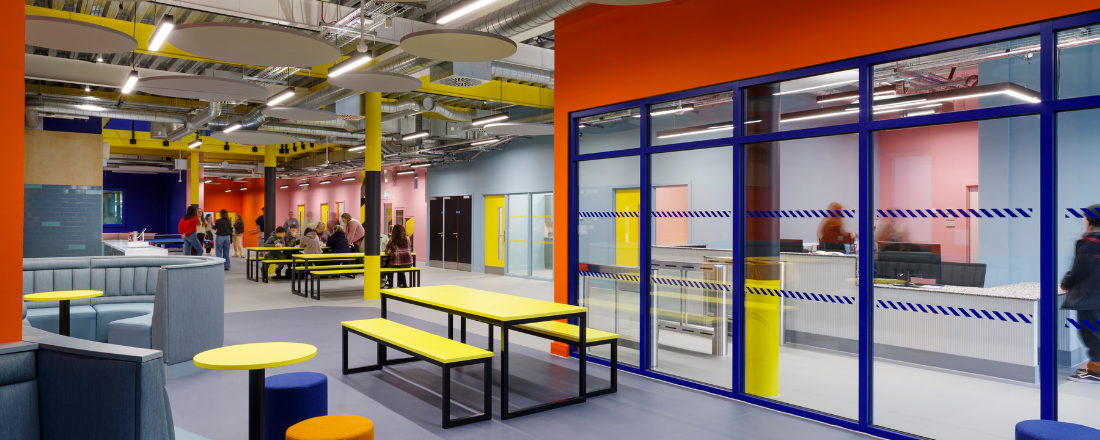
Link up: Youth centres are opening across the country from Carlisle to Croydon
By 2027, charity OnSide is set to have opened 22 Youth Zones. Kimberley France visits the latest one in Preston, with photography by Gareth Gardner


Publishing and Events Assistant,
The Developer and Festival of Place
Publishing and Events Assistant,
The Developer and Festival of Place
In 2025, the stark reality of growing up in England was set out in the Youth Matters: State of the Nation report, written by a group of young people from all over England, which sums up the situation in four words: “It’s tough out there.”
Government funding for youth services has fallen by 73 per cent since 2010 – cuts that had led to the closure of 1,243 council-run youth centres across England and Wales by 2023. According to figures obtained by Unison, 42 per cent of local authorities admitted they had no council-run youth centre in their area.
At least one charity is trying to fill the void. OnSide raises funds to build youth clubs in the UK’s most disadvantaged areas staffed with skilled youth workers.
These Youth Zones provide affordable access to high-quality sports, arts and leisure facilities and activities, seven days a week, 52 weeks a year, for those aged 8-to-18, or up to 25 if they have additional needs.
OnSide’s network now includes 15 Youth Zones, in locations from Carlisle to Croydon, Wirral to Grimsby. By 2027, this will have grown to 22 locations, and 80,000 young people will be within the reach of a facility.
OnSide raises the funds and develops the business model and physical space for each Youth Zone, then hands it over to a local charity partner. These multimillion-pound facilities are rooted in collaboration with communities, local authorities and private supporters.
The Youth Zones draw on the template set by Bolton Lads and Girls Club, which was previously chaired by entrepreneur Bill Holroyd; the experience led him to set up OnSide in 2006, so that more towns could enjoy similar facilities.
OnSide’s network now includes 15 Youth Zones, in locations from Carlisle to Croydon, Wirral to Grimsby. By 2027, this will have grown to 22 locations, and 80,000 young people will be within the reach of a facility.
Four of the centres have been designed by architect John Puttick Associates, including Vault Youth Zone in Preston. At the time of my visit, the youth centre has just opened as part of the wider regeneration of the city’s iconic bus station and surroundings.
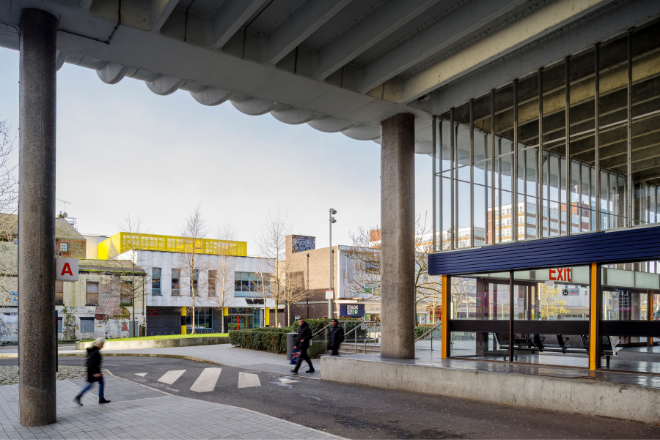
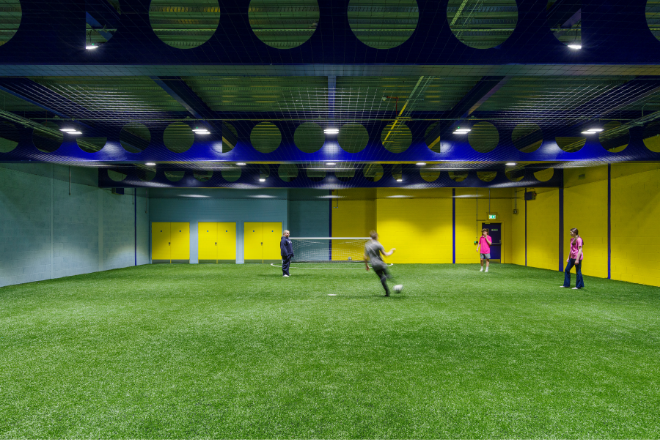
A beacon in an expanse of public space, Vault sits just outside the bustle of the main high street. With its playful zigzag facade and bright pops of yellow, the building appears compact and approachable – surprising given it hosts a full sports hall, rock-climbing wall and football pitch. You wonder where it all fits, until you see the large volumes around the back.
OnSide’s chief executive, Jamie Masraff, explains that the right location is key. “The facilities are deliberately placed in neutral, accessible and prominent locations – close to transport, visible in the townscape and open to all – to maximise the likelihood that thousands of young people will walk through the doors,” he says.
“We would want to avoid industrial areas and out-of-town retail which tend to be accessed by car, as this would be a barrier. We also avoid areas with a high concentration of night-time economy, which could make it unsafe.”
Vault isn’t just for young people; it’s also shaped by them, from picking the name to interviewing future employees hired as youth workers. This helps embed a feeling of ownership and belonging
It’s also important that the centre is not imposing to walk up to. Big windows offer a glimpse of what’s happening inside. Although roadworks are ongoing when I visit, once complete, the only barrier between the pedestrianised public space out front and the Youth Zone will be a single-lane bus-only route. Crucially, this means young people can arrive independently, safely and confidently, with public transport delivering them directly to the front door.
“One of the nicest things about the windows is that they generate excitement for young people,” says Youth Zone head of fundraising and communications Gaby Ingham. “These buildings don’t hide young people away – they put them at the heart of the community.”
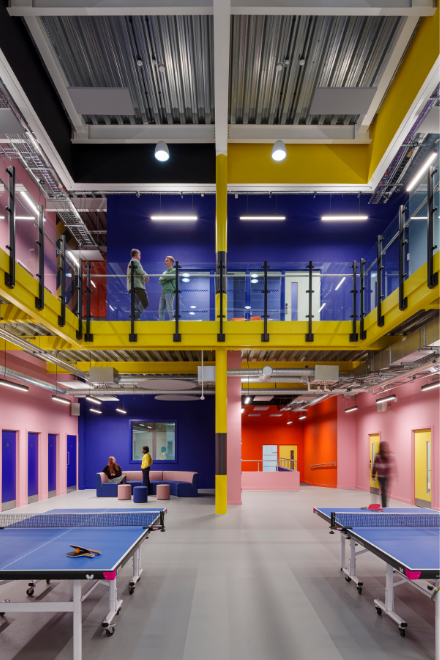
Inside the centre, you can see into some of the 20 programmed activity areas without taking a step further than reception. The rock-climbing wall rises up through the double-height space while, to the sides, rooms for cooking, making and recording are visible in a neat row.
It costs £5 per year to be a member of Vault plus a charge of 50p per visit. The payment is a nudge, explains Vault’s marketing and communications director Stephen Burton. “It gives the youth that psychological connection to say: I own this space, I respect this space, I trust the staff and I’m not going to mess it up.” Before it fully opened, Vault had already sold over 500 memberships.
Yet Vault isn’t just for young people; it’s also shaped by them, from picking the name to interviewing future employees hired as youth workers. This helps embed a feeling of ownership and belonging from day one.
Each Youth Zone has a Young People’s Development Group, who take part in a range of meaningful engagement activities that go beyond branding and graphic decisions. Youths are encouraged to join visits to other Youth Zones and explore different layouts, activities and design approaches, then feed back directly to the property and construction team on what they would like to see included. At Vault, their input is reflected in more private booth-style cafe seating and the inclusion of girls-only sessions.
“If they’re playing a game of Fifa, we can say: why don’t you go and play a game of football instead?”
On the day that I visit, a small group of children from a nearby school are touring the centre. Some kids head straight to the ping-pong tables while others laser in on the football pitch, visible through one of the windows at the back of the space.
That sense of easy orientation, allowing young people to scope out the activities before committing, lowers the boundaries of each space and softens the transition from passive onlooker to participant.
It’s a purposeful design choice by the architects, working to the OnSide brief or “blueprint”, which states that Youth Zones should “invite participation and encourage young people to engage on their own terms”.
“Young people might want to participate in something but not feel confident enough to actually step through that boundary,” says Ingham.
One of the only spaces not behind glass is the video gaming area. OnSide’s Generation Isolation report found that 76 per cent of young people spend their free time on screens. OnSide hopes to make it easier for gamers to socialise and provide opportunities for gamers to be drawn towards other activities on offer.
“We wanted to draw them out, away from the screens if they want to,” says Ingham. “If they’re playing a game of Fifa, we can say: why don’t you go and play a game of football instead?”
OnSide’s own research found that 34 per cent of young people are very lonely, 20 per cent don’t have a safe place outside of school and 43 per cent have high feelings of anxiety. But 92 per cent of those that attend a youth centre say it makes a positive difference.
This kind of gentle redirection is a wider spatial objective of the centre so that no single interest is siloed in the space.
“To get to the fitness, you’ve got to walk past everything else and then vice versa”
“We deliberately try not to group all the sports together, so they’re scattered around a bit more,” says architect John Puttick.
“Because the sports rooms tend to be quite big, I think if you’re a very sporty kid, you could easily come to the youth centre and just go to the sports bit. But here, to get to the fitness, you’ve got to walk past everything else. And then vice versa, if you’re interested in music, you walk past the climbing wall. Maybe you’re tempted by something you wouldn’t necessarily have normally done.”
Once the centres are up and running, each Youth Zone is operated as an independent charity. Funding comes from patronage or sponsorship from organisations keen to put their branding on a room – such as the recording studio. Vault also has a beauty room with a hairdressing chair, and a maker space with machinery and materials. Member facilities include a professional gym and boxing space. There’s also a fully fitted kitchen to provide £1 hot meals each evening.

But young people can also just do nothing – and that’s key. In the National Youth Strategy Survey, published as part of the Youth Matters: State of the Nation policy report, one of the top five things young people said they wanted was access to local, safe and accessible public spaces.
One young person in the report says: “What really stings is the lack of places to just be. Outside of school, there isn’t much for my mates and I to do in person. Few youth clubs, few affordable activities, and often, the thought of getting anywhere safely, especially after dark, is a barrier. We need spaces to just hang out, make friends, and frankly, just have some fun without the constant pressure of ‘what next?’”
“Young people feel shut out of their own communities"
Research has shown the impact goes beyond wellbeing. In her research, Carmen Villa, assistant professor at the Department of Economics of the University of Zurich found that youth centre closures worsened academic performance in exams.
“These places need to become a third space for people to come and feel safe,” says Vault chief executive Tim Jacques. “Sometimes they need to be outside of home to be safe, don’t they?”
“At a time when youth clubs are closing, shopping centres and parks feel increasingly off‑limits, and when public perception turns against them, young people are increasingly feeling like they are being shut out of their own communities and their aspirations held back,” adds Masraff.
“OnSide Youth Zones work because they are designed with young people to send a clear, vital signal: that they matter and are worth investing in.”
Kimberley France is publishing and events assistant at The Developer. She holds a Part 1 architecture degree from London South Bank University and is currently studying at the London School of Journalism
If you love what we do, support us
Ask your organisation to become a member, buy tickets to our events or support us on Patreon
Sign up to our newsletter
Get updates from The Developer straight to your inbox
Thanks to our organisation members
© Festival of Place - Tweak Ltd., 124 City Road, London, EC1V 2NX. Tel: 020 3326 7238